
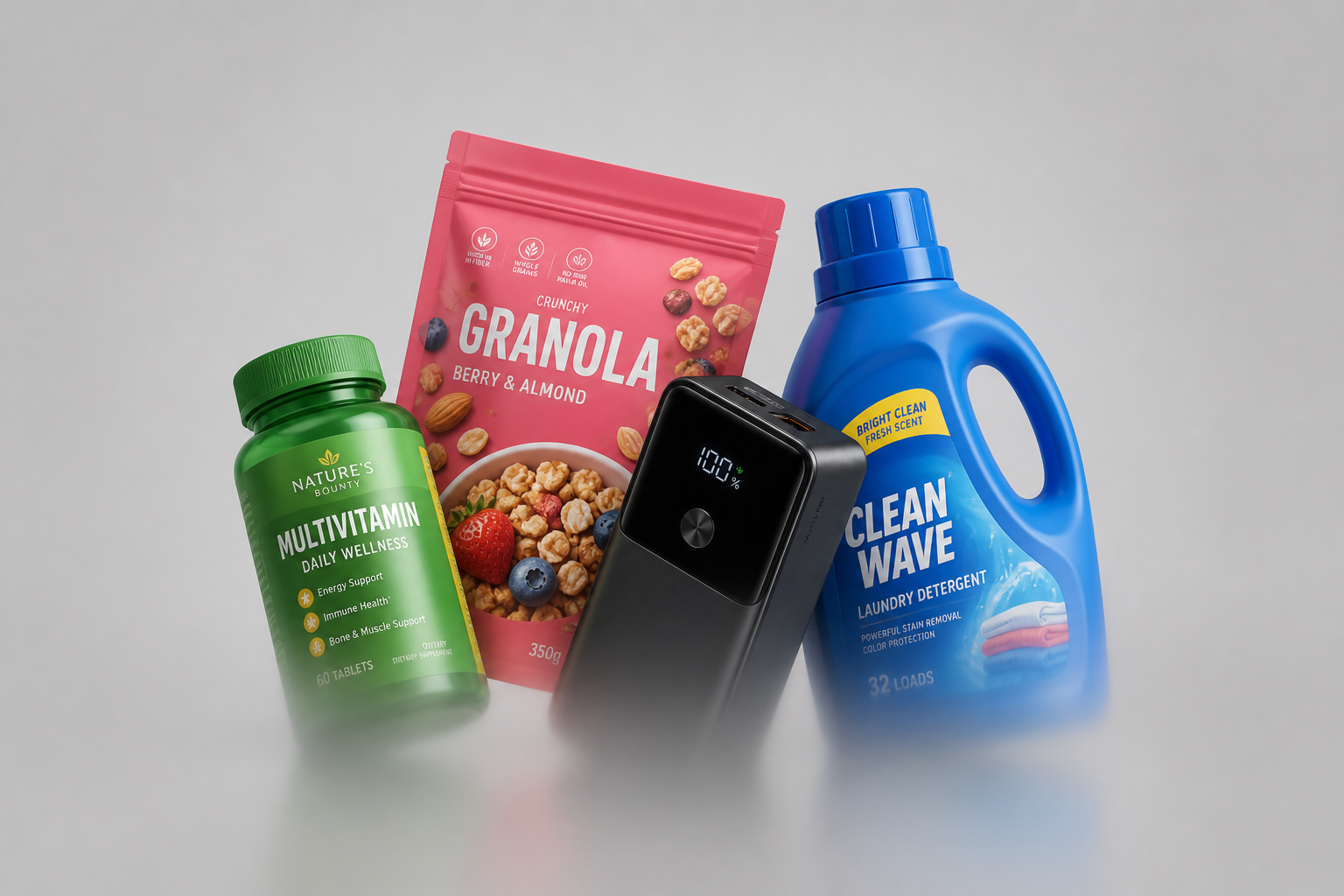
Enrich Your Catalog
Without
the Manual Work.
AI generates titles, descriptions, attributes, categories and units of measure from your raw PIM records bound by your brand rules and a human-in-the-loop quality gate.
What We Automate
Comprehensive enrichment from titles to SEO.
Scroll through process arrow_downward
Product Titles
Consistent naming conventions (brand → type → variant → size) in multiple languages, respecting channel limits.
Copywriting
Marketing descriptions for the card, technical descriptions for PDPs, and bulleted benefits in your tone of voice.
Attributes
Structured JSON: color, material, ingredients, dimensions strictly mapped to your attribute schema.
Categorization
Multi-level mapping to your category tree, plus tags for smart navigation and faceted filtering.
Units of Measure
ml vs g vs pcs automatic contextual detection, display normalization, and typo correction.
SEO Meta
Meta titles, descriptions, image alt text, and schema.org Product structured data for Google visibility.
CALCULATE YOUR SAVINGS
PIM industry baselines for manual enrichment land around 4 minutes per SKU. Plug in your catalog size and see how much time the pipeline gives back to your team.
Baseline: ~4 minutes per SKU for manual enrichment (titles, descriptions, attributes, categorisation, SEO meta) — consistent with figures published by Salsify, Akeneo, and Productsup. Pipeline benchmark: ~4 seconds per SKU on real customer catalogs. An 8-hour working day = 480 minutes.
HOW IT WORKS
Six steps. Deterministic where it has to be, AI where it pays off. Your hand-approved examples are the quality benchmark.

Pull raw data
CSV from Akeneo, Excel from suppliers, JSON from REST APIs, photos from S3. Everything maps onto your unified schema.
Brand rules as code
Naming conventions, allowed categories, tone of voice, banned words, unit formats. Encoded not suggested to the model.

Few-shot on your examples
LLMs with the most similar examples from your hand-approved catalog. Different models for different fields.

Quality gate before publish
Length checks, unit checks, semantic agreement between title and description. Suspicious goes to review, the rest flows straight to PIM.

Push back to your system
Akeneo, Pimcore, Shopify, Magento, WooCommerce or a custom PIM via API. Incremental only changed rows.

Learn from corrections
Every human correction becomes a new few-shot example. The pipeline gets sharper every week without retraining.
INPUTS → OUTPUTS
Whatever shape your supplier data arrives in, we map it onto a clean, channel-ready record.
- →Supplier Excel/CSV in any column order, with merged cells, multilingual values and inconsistent SKUs.
- →Product photos (S3, Drive, FTP) for visual attribute extraction — colour, material, packaging type.
- →Raw GTIN/EAN codes, manufacturer part numbers, supplier model names.
- →Existing PDF datasheets, technical specs and brochures.
- →Partial PIM exports — gaps and inconsistencies are part of the input, not a blocker.
- →Brand guidelines: tone of voice, banned words, naming patterns, category tree.
- →Channel-ready titles with strict length limits per surface (Google Shopping, Amazon, your storefront, marketplaces).
- →Marketing copy for the listing card and a longer technical description for the product page.
- →Strictly-typed attribute JSON: colour from an enum, dimensions in mm, weight in g, material from a fixed list.
- →Category path mapped to your taxonomy plus secondary tags for search facets.
- →SEO bundle: meta title, meta description, image alt text and schema.org Product JSON-LD.
- →An audit trail per field: source, model used, confidence score and reviewer.
BUILT FOR THESE SCENARIOS
Different catalogs, different rules. The pipeline adapts — same architecture, your taxonomy.
Fashion & apparel
Size charts normalised across brands, fabric composition extracted from spec PDFs, season tags, fit descriptors picked from a controlled vocabulary so search facets stay clean.
Beauty & cosmetics
INCI ingredients parsed and standardised, allergen flags surfaced, volume normalised to ml, claims (vegan, cruelty-free) restricted to a verified list, descriptions per market language.
Electronics & tech
Specs extracted from manufacturer datasheets — connectors, voltages, throughput. Compatibility tables generated. Models grouped into families. Hard limits prevent hallucinated specs.
Grocery & FMCG
Net quantity vs. drained weight handled correctly, allergens called out per regulation, country-of-origin extracted, storage instructions standardised, halal/kosher flags carried from supplier data.
B2B & industrial parts
Manufacturer part numbers preserved exactly, cross-references to OEM equivalents generated, technical drawings linked, units kept in the engineering convention (Nm, bar, IP rating).
Marketplaces & aggregators
One source record, multiple channel-shaped exports. Each marketplace gets the title length, attribute schema and category code it expects — no manual reformatting per channel.
WHERE IT PLUGS IN
No rip-and-replace. The pipeline reads from your sources and writes back into the systems your team already uses.
Where data comes from
Akeneo, Pimcore, custom MySQL/Postgres PIMs, supplier portals, Excel/CSV drops on SFTP, REST APIs, ERP exports (SAP, Oracle, Pantheon, Minimax), Google Drive folders and S3 buckets.
How the work happens
Multi-model orchestration: small models for normalisation, larger models for prose, vision models for photos. All wrapped in a deterministic rule layer with retries, validation and a human review queue.
Where data lands
Shopify, Magento, WooCommerce, BigCommerce, Salesforce Commerce Cloud, your custom storefront via REST/GraphQL, marketplace feeds (Google Shopping, Amazon, eMAG, Limundo) — or back into the same PIM you started in.
per product, by hand
per product, in pipeline
first-pass acceptance
supported languages